We’ve all had that favorite pair of jeans. They’ve been with you through seasons of life, they fit like no other, they carry memories. And then one day… they rip. What now?
Here’s my shortcut: do not recycle them yet. Let’s fix them.

A Story from My Early Days
Back in fashion school (many lifetimes ago), my first boyfriend was obsessed with Evisu jeans. They were beautiful, expensive — and they always tore in the crotch. So I patched them. With whatever fabric scraps I had: checkered cotton, leather leftovers, bold colors. I laid them over the tear and just patched the edges, so I didn’t have to worry about the thick seams that are in the crotch area.
It worked. And the repairs fit the brand’s attitude. Imperfect but authentic.
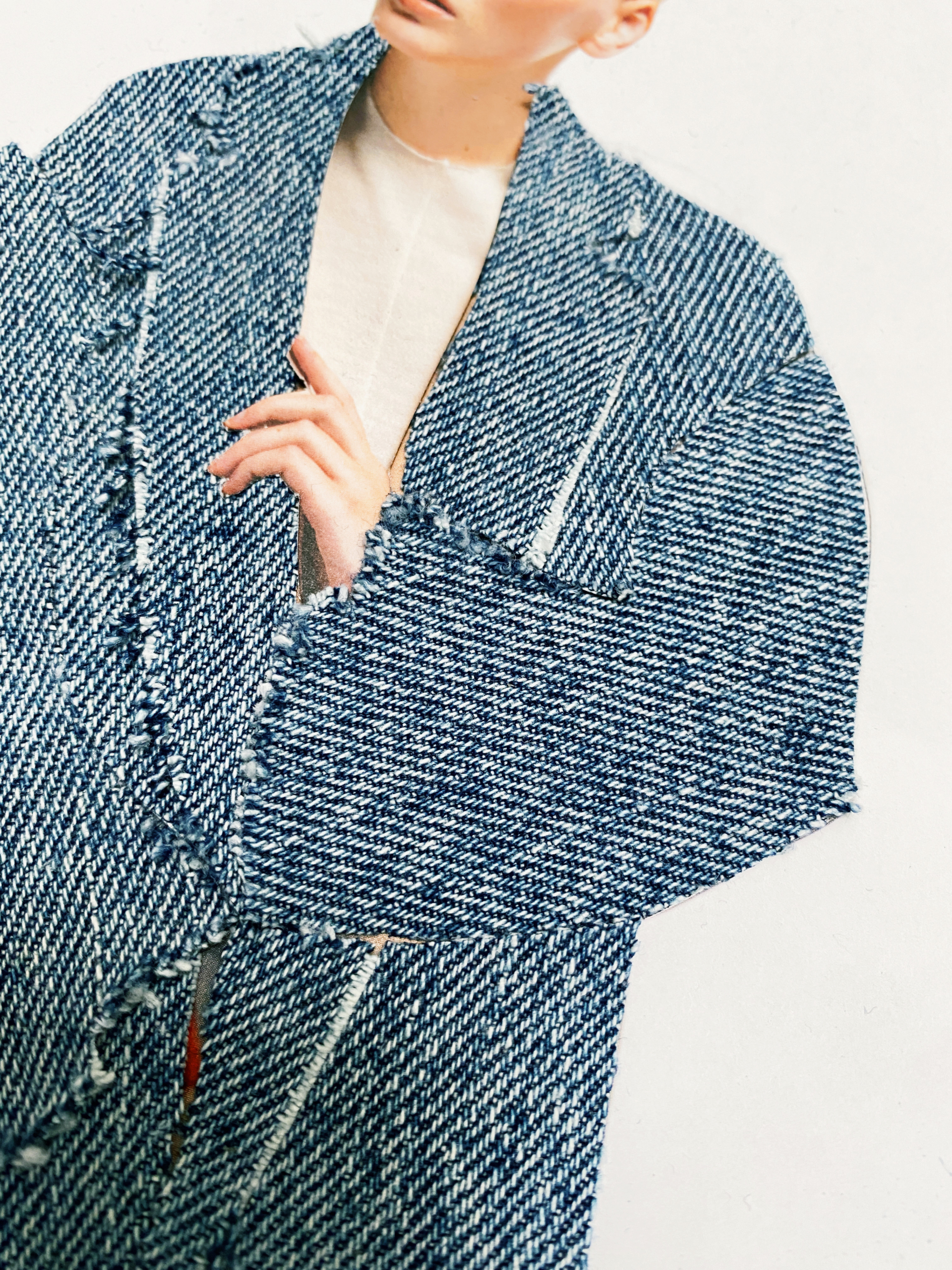
Fast forward to now: I still mend denim. My shorts rip below the back pocket. My husband’s vintage Levi’s split along the crotch, all the way across the seat. These are pieces too beautiful and too comfortable — too lived in — to give up on (even though my jeans will have a life after in my artworks, I still prefer to wear them for as long as possible). So I keep fixing.
Mending can be done with a sewing machine, or by hand. You don’t need any expensive or special tools. It becomes a design choice to repair. Japanese repair their ceramics with gold, to show the cracks and basically tell the story of repair, love, and appreciation. It’s called kintsugi. We will do the same, but then for clothing. And the Japanese have this other beautiful way of decorating with a thread, called sashiko.
Why Mend Denim?
Denim is a gorgeous fabric that comes in many shapes, colors, and qualities. The one that is easiest to repair is the one that is fully cotton, because you don’t have to worry about the stretch. Those are usually also of higher quality, have formed itself around your body, and will be most worth it to mend.
These jeans have been with you for a while. They tell a story, and by mending, you extend that story and memories. It’s almost symbolic to extend the life of clothes, to value craftsmanship and the many hands that made your garment initially.
You can choose between visible mending (contrast patches, or visible stitches) or sophisticated with matching stitch to the body color. It becomes a design choice to repair. Japanese repair ceramics with gold, to show the cracks and basically tell the story of repair, love, and appreciation. It’s called kintsugi. Visible mending has the same sentiment.
Most people think mending is too hard, but I promise you: it’s simple, fun, and meaningful. It can be done with a sewing machine, or by hand. You don’t need any expensive or special tools. Some areas are more complicated to mend, such as the crotch, where a lot of thick seams come together.
Let’s recap:
- Cotton denim (without stretch) is the easiest to repair and usually the most worth it — it’s high quality, molded to your body, and full of memories.
- Every repair is a chance to extend that story: honoring the craftsmanship that made the jeans in the first place.
- Visible mending becomes a design choice. Like Japanese kintsugi (repairing ceramics with gold), you can show your stitches proudly. Or you can keep it subtle with hidden reinforcement.
Two Ways to Repair
1. Visible Mending
Bold, decorative, and symbolic.

Sashiko style
- Measure the rip in length and height, adding 1 cm more on each side.
- Find a nice fabric that you want to use and cut it in that size, adding a cm to each size
- Iron that 1 cm on each side, to the inside, so you have a clean finish.
- Use pins to attach the fabric to the denim of the pants. This can get a bit finicky. But basically, the only step that takes the most time. The fabric can slide, and you could be pinning the space of the rip. This is part of the fun and the puzzle! Don’t get discouraged. It also still happens to me.
- Check the inside of the jeans and make sure the whole rip is covered
- Find your embroidery yarn and use a decorative stitch. You keep going and this becomes very meditative.
- Tada! Done!


Other options:
- This can also be done with a patch under, honoring the shape of the rip.
- Or you could make the rip in an even shape (like a rectangular) to make it even more decorative and a design feature.
- You could also use a patch and sew that around the corners for a matching stitch. I would still do it by hand, but it will be more matching. See what fits your aesthetics!
This turns the tear into a feature — a mark of love, not damage.
2. Matching stitches
Subtle and practical.

This is what you do:
- Measure the rip and cut a piece of fabric slightly bigger than your measurements. I usually like to use cottons or linen – fabrics that don’t add to much weight to the rip.
- You add this behind the rip, and you slowly start pinning it to the denim
- Keep going until you can hold your jeans up for results and the piece of fabric doesn’t come loose
- Make sure you didn’t add in too much space in your rip + the fabric, because then you have created a sort of 3D bubble. The seams of the rip should be close to touching each other.
- Have your sewing machine set up with matching threads and just the basic stitch
- Now you start on one side, and you go over, back and forth, perpendicular to the rip (so if the rip is horizontal, which it most likely is, then you stitch over it vertically).
- Keep going until the whole rip is covered and reinforced.


This leaves only a faint grid of stitches on the outside but makes the area stronger than before. This method does make this are a bit heavier and could feel a bit stiffer. This will get better after a few wears.
Tip: Avoid synthetic “iron-on” patches. They peel and curl after washing. Fabric + stitches always win.
What Denim Teaches Us
As a former denim designer, I spent years obsessing over tiny details: the exact placement of back pockets, the thread story, the strength of seams. A pair of jeans is built up in several “non-negotiable”: back pockets, front pockets, a fifth pocket (or coin pocket, that small one in your front pocket), belt loops, a waistband, a fly or buttons, back pockets, and a back yoke. Most of the seams in your jeans are fell seams, or felt seams — both are used interchangeably these days, for durability. Denim yarn or thread is also a thicker yarn. This is done for functionality of strength, but also looks better with all these thick seams.
I used to spend hours, if not days, to match thread colors to a specific selection of a wash. making a nice color story of yarns for a pair of jeans. It was really humble work, but I loved it. As a denim designer, it’s mostly about small details; the pocket positioning, the color of the yarn, the size of the stitch. And what kind of metal trims.
When you mend your jeans, you’re not just saving fabric. You’re honoring that process. You’re saying: this story isn’t over yet.
Tailor or DIY?
If you can thread a needle, you can repair denim. But if you prefer, you can bring it to a tailor. Just be specific:
👉🏾 “Please reinforce this seam with a matching fabric on the inside.”
👉🏾 “Could you sashiko-stitch this patch on top of the tear?”
👉🏾 “Could you use matching stitches to reinforce the tear?”
In Singapore, not all tailors are comfortable with denim because there is a lack of experience with the fabric due the weather, so showing pictures (like the ones in this article) really helps. And ask them if they’re comfortable doing it (and double check again).
My Favorite Part: Teaching Repair
Recently, at a Fashion Revolution mending event, I guided women through denim repairs. Many came in convinced their jeans were “beyond saving.” The joy on their faces when they realized they could do it themselves — priceless.
Repair isn’t shameful. It’s powerful. It’s adding another chapter to the story of your clothes.
Want More?
This article is just a glimpse. Soon, I’ll host Denim Safari — an online workshop designed to empower you to make the best choices when shopping for jeans.
We’ll go from scrolling online shops to walking into physical stores, looking at both high-end brands and fast fashion. I’ll guide you through:
- Fabrics — which ones last, and which ones don’t.
- Design details — the small things that signal quality.
- Pocket positioning & back yokes — why they matter more than you think.
- Washes & finishes — how they affect fit, comfort, and longevity.
Forget about outdated “body proportion rules.” This workshop is about tuning into what works for you and your lifestyle — so you stop collecting six unworn pairs and finally find that one favorite you’ll actually live in.
It’s filled with practical tips, drawn from my years as a denim designer and boutique sales assistant, plus insights from real women I’ve dressed, and examples spotted on the street. And because it’s live (and recorded), there’ll be space for your questions so we can make it truly interactive.
Because shopping for jeans shouldn’t be painful — it should be empowering.
Subscribe here:
Final note: Don’t throw your jeans away. Mend them. Wear them. And when they’re truly at the end of their life, that’s when they can become something new — even art.